Showing posts with label Brian Kane. Show all posts

Monday, February 13, 2023

Mark Schultz on Continuing the Legacy of Prince Valiant


Something very special today to celebrate the 86th anniversary of the Prince Valiant adventure strip.

It’s Jim Lockwood’s wonderfully informative article (with added images and links) on Prince Valiant writer Mark Schultz. Lockwood’s piece was first published last month – January 29, 2023 – in The Times-Tribune of Scranton, Pennsylvania.

_________________


Writer Mark Schultz Hopes to Stay True to Characters
As He Carries Legacy of Prince Valiant Adventure Strip


By Jim Lookwood
The Times-Tribune
January 29, 2023

Mark Schultz has enjoyed Prince Valiant in the Sunday comics pages since childhood.

At that time, in the late 1950s and early 1960s, the popular adventure series by comics pioneer Hal Foster [left] was in its 20s, having debuted Feb. 13, 1937.

“Boy, I can remember Prince Valiant, seeing it in the newspapers from the time before I could even read and having my parents read it to me. At a certain point, I started cutting it out and collecting it, pasting it into a big scrapbook,” said Schultz, 67, who grew up in Pittsburgh and the Lehigh Valley and has lived with his wife, illustrator Denise Prowell, in Clarks Summit since 1993.

His early love of comics partly led him to pursue a career in art and become part of the Prince Valiant legacy. In 2004, Schultz became only the third writer of Valiant, which is the longest-running adventure strip in the world. Turning 86 [on February 13, 2023] and among the last of the classic adventure strips, Prince Valiant is syndicated by King Features Syndicate and appears in about 300 Sunday newspapers in the nation.

Above: The opening panel of page 4,120 of Prince Valiant (January 24, 2016),
with art by Thomas Yeates and text by Mark Schultz.


Joe Figured, promoter of the annual Scranton Comic Con, said Schultz attended the convention a few times over the years, most recently in November. Having a noteworthy person in comics appear in person is a big plus, Figured said.

“There’s nothing better than to go into a show and meet the writers and artists. That’s the fun part of it,” Figured said.

The Prince Valiant strip currently is drawn by artist Thomas Yeates [right] of California. While Schultz writes the weekly plots, he also is a noted illustrator and first made a name for himself in the comics industry in the 1980s.

Schultz’s parents both hailed from the Scranton area. His father was from Dunmore and later the Abingtons and his mother was from the Abingtons. In his youth, Schultz’s interest in art grew, also inspired by science fiction, mythology and dinosaurs, among other subjects.

“I’m very much interested in speculative fiction, you know, imaginary stories, kind of adventurous stuff, but I also have a real serious interest in the sciences and paleontology being part of that,” he said.

He attended Kutztown University and earned a fine arts degree in painting in 1977. He pursued a career in commercial art and some of his early work involved illustrating how-to guides. A comics revival of the early 1980s drew him into that art form.

In 1986, Schultz created the comic book series Xenozoic Tales. It found a following within the comic book universe and became the basis for a short-lived cartoon called Cadillacs and Dinosaurs, for which Tyco produced an entire toy line.

“There was a real growth period in the mid-80s. And I was lucky to come on board at that time, because they were looking for artists, they were looking for new ideas. That was hitting a growing business at the right time,” Schultz said.

By the mid-’90s, Xenozoic Tales ended and Schultz freelanced. He wrote and illustrated for comics, including Aliens, Predator and Flash Gordon, and for a few years wrote the storyline for Superman, Man of Steel. Schultz also has given seminars at Marywood University and at Savannah College of Art and Design in Georgia, and has exhibited artwork at Marywood, Penn State and in Spain.

In 2004, the Prince Valiant writing gig arose when Hal Foster’s first successors, John Cullen Murphy and his son, Cullen [right], decided to pack it in. King Features Syndicate then tapped artist Gary Gianni and Schultz to take over Valiant.

Gianni was succeeded by Yeates in 2012. Schultz said his philosophy toward writing Prince Valiant has been to try to stay true to Foster’s legacy.


“Basically, what we try to do now is just not screw things up. We want to stay true to the characters,” Schultz said. “I hope I continue the legacy of Prince Valiant in a manner that is in keeping with the original intent.”

At Valiant’s start, its visual vibrancy provided “an oasis of color in a gray world” of the Great Depression and came during a time when other entertainment options were limited, said Brian M. Kane, Ph.D, a Foster biographer and comics historian of Ohio.

Foster came into Valiant with a fan base from his work doing Tarzan for several years.

“He brought those people along with him and his artwork exploded off the page,” Kane said.

Foster’s realistic command of anatomy also became the mold for superheroes that followed, he said.

Rooted in Arthurian legend and medieval England, the strip also reflected the times in which it was being created, Kane said. Foster’s strip referenced subjects ranging from polio to bullying to strong, independent women to mixed-race couples, Kane said.

The strip’s enduring popularity also stems from its dual-focus on adventure and family plot lines, Kane said. Valiant fell in love with and married Aleta, the Queen of the Misty Isles. In 1946, their child, the first baby “born in the comics,” arrived and was covered in newspapers like a celebrity birth, Kane said.

Twins later followed. The children reflected the post-World War II baby boom, Kane said.

“It’s one of those things that when Hal Foster started it, it was just a plain adventure strip. Then a few years into it, Val meets Aleta and falls in love and it becomes a dual adventure strip and family strip,” Kane said. “There was as much story about raising a family as there was going on adventures,” Kane said.

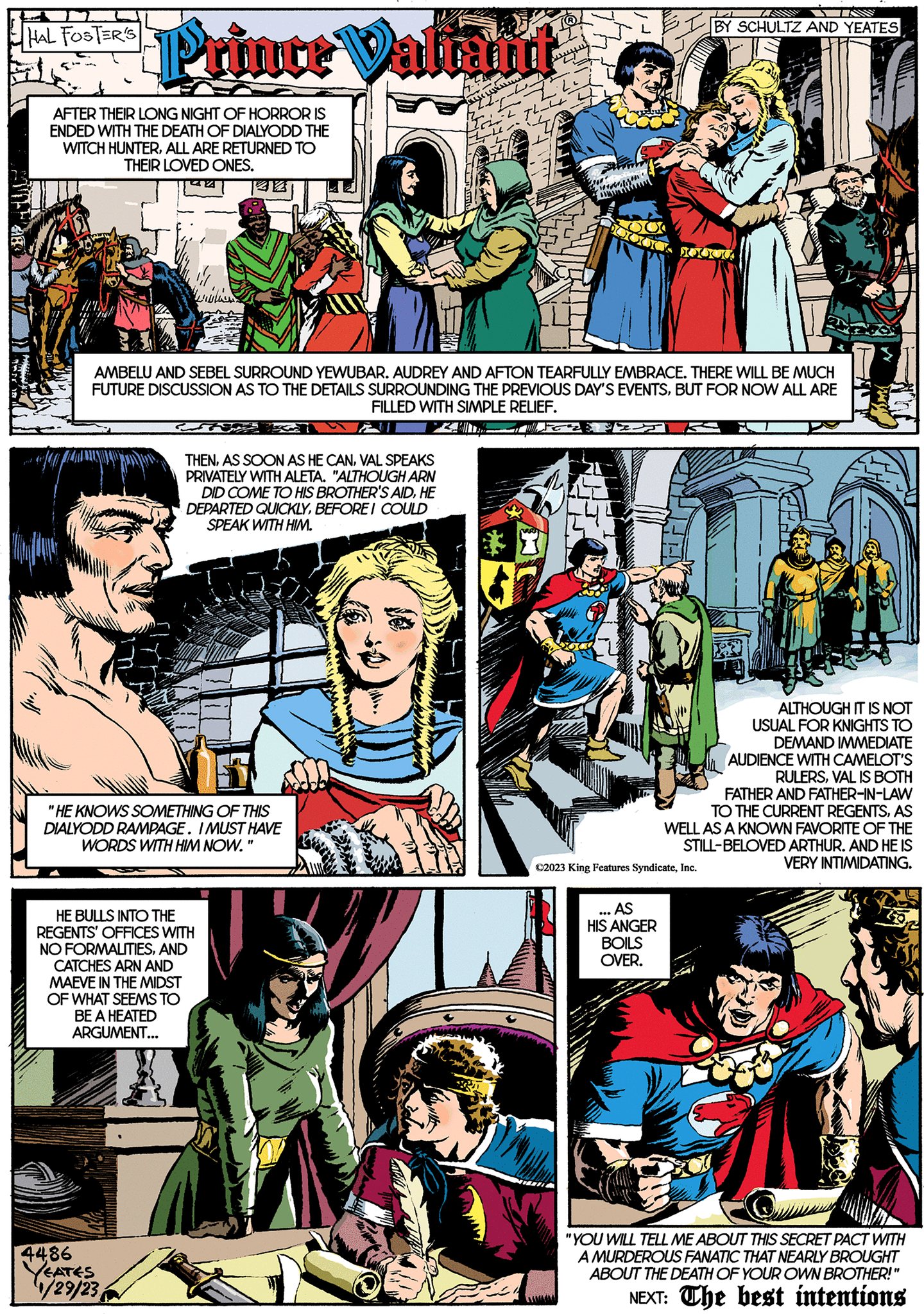
Sunday’s edition of Prince Valiant [January 29, 2023 (right)] will be number 4,486. Schultz, whose first Valiant appeared Nov. 21, 2004, with edition number 3,537, has authored 949 editions. Schultz said he and Yeates go back-and-forth with ideas, outlines and drawings in fleshing out a strip.

“Mark is very good at writing to the strength of the artist,” Kane said. “He wants to keep the artist interested in order to produce good work.”

Schultz also created a heavily illustrated novella titled Storms at Sea that came out in 2015, and he is now working on a sequel. He also continues to work with Flesk Publications that regularly publishes his collections of drawings.

Schultz also wrote a 2009 book illustrated by others and titled The Stuff of Life, A Graphic Guide to Genetics and DNA, and wrote and co-created SubHuman, an undersea comic book adventure debuted in 1998.

How long might Schultz continue writing Prince Valiant?

“My feeling right now is probably when Thomas (Yeates) decides to cash in his chips, I’ll probably be ready to go, too,” Schultz said. “To get on board with a new artist seems just probably, after this amount of time, it’s probably time for me to move on and let a new writer give a try at it. Who knows? That might be a long time” to come.

Kane hopes Prince Valiant continues for a long time.

“I would love to see it go on for many, many more years. I would like to see it hit 100 years,” Kane said.

Jim Lockwood
The Times-Tribune
January 29, 2023


Related Off-site Link:
Catching Up With Mark Schultz – Jason Bergman (The Comics Journal, March 14, 2022)

See also the previous posts:
Mark Schultz on the Art of Hal Foster: “Uniquely Appealing, Innovative and Influential”
Mark Schultz on Prince Valiant as an American Invention
Thomas Yeates, the New Illustrator of Prince Valiant
Thomas Yeates: “My Biggest Thrill is Seeing the Prince Valiant Logo on My Drawings”
How It All Began
“Beautiful, Captivating and Utterly Awe-inspiring”
Commemorating Hal Foster and Prince Valiant
John Cullen Murphy on Prince Valiant: “It’s My Duty. I’m Responsible For It”
Former Prince Valiant Writer Cullen Murphy Interviewed by Terry Gross
Remembering Episode 3000, 8/7/94
Gary Gianni’s Prince Valiant: Looking Good
Prince Valiant Celebrates 75th Anniversary
Something Very Special
“He Wasn’t a Superhero But He Was a Hero”
4000
Comics’ Sweeping Graphic Novel, Prince Valiant, Turns 80
Celebrating 85 Years of Prince Valiant
A Valiant First Effort, Wouldn’t You Say?
A First for Prince Valiant
Prince Arn, Son of Valiant and Regent of Camelot
“We Are the Daughters of the Queen of the Misty Isles and the Prince of Thule”
The Return of Karen and Valeta
Galan to the Rescue
Nathan

Sunday, July 18, 2021

Ahead of His Time

By Guest Contributor Brian Kane

Prince Valiant creator Hal Foster was ahead of his time, tackling issues of bullying (the Giant in 1940), women’s rights (Aleta since the 1940s), bi-racial couples and children (Boltar, Tillicum and Hatha – 1952 and 1953), men showing their emotions (1940 Val, Gawain and Tristram parting – “and the tears run freely down bronzed cheeks . . . for in those days brave men had not learned to be ashamed of their emotions.”), and prejudice against the physically disabled, Jews, Arabs, and Blacks.

Because Foster never drew something without a reason, it makes me wonder if a character in Prince Valiant, page #757, August 12, 1951, panel 1, striking a traditionally feminine pose, might be gay. The crew’s reaction is to Arf, “the singer of songs who made the lonely hours of the night watch seem short.” I am not suggesting anything happened between the two, but the crew member’s reaction to Arf’s leaving needs some discussion.

The pose was not uncommon; it appeared in silent films, and is similar to that of Bugs Bunny in drag playing the Valkyrie Brünnhilde in the Chuck Jones classic “What’s Opera, Doc?” (Warner Bros., July 6, 1957 – almost six years after the Foster panel appeared). Any thoughts?

Monday, February 13, 2017

Comics’ Sweeping Graphic Novel, Prince Valiant, Turns 80

.

By Brian M. Kane


Before television, when most films were still black & white, the Sunday comics were an oasis of color in a Depression-era gray world. Highly popular comic strips drove newspaper sales in the early twentieth century, so it is little wonder why their creators were regarded as celebrities. The epic Prince Valiant in the Days of King Arthur by Harold Rudolf “Hal” Foster premiered in the color comics section on February 13, 1937 (left). Prior to Prince Valiant, Foster originated the adult protagonist adventure strip genre by adapting Tarzan as a black & white daily strip in 1928, which was followed by the Tarzan color Sunday feature from 1931-1937. Faced with imposing financial and creative constraints as a work-for-hire artist, Foster focused his considerable skills as an illustrator towards producing his own strip. The extraordinary effort resulted in international prominence for both Prince Valiant and Foster. Today, after 80 years, “Val” remains one of the few adventure strip characters still in print.


Above: Detail of the November 4, 2016 installment of Prince Valiant
by the strip's current illustrator, Thomas Yeates.


It is difficult to imagine the impact Foster’s Prince Valiant had on 1930s and 1940s popular culture. When Prince Valiant began, Superman’s debut in Action Comics #1 was still over a year away. Many of the first two generations of comic book creators owe a great debt to Foster (right). Young comic book artists studied Foster’s technique, sometimes copying panels from his strips. “Swipes” of Foster’s art can be found in the origin of Batman, and comics drawn by Jack Kirby, the co-creator of many of today’s movie heroes, including Captain America, The Avengers, The X-Men and Thor. Most importantly, Val epitomized a knightly moral code, creating an ethical standard of conduct that exemplified truth, justice, and what it meant to be a hero.


Seminal works such as The Hobbit, The Sword in the Stone, and The Chronicles of Narnia were non-existent in February of 1937. By the time Joseph Campbell’s groundbreaking The Hero with a Thousand Faces was published, Prince Valiant had already spent twelve years on his own mono-mythic hero’s journey. Yet, unlike Campbell, Val’s adventures included strong, self-reliant, heroic women; attesting to Hal’s wife, Helen’s influence on the strip.

To the uninitiated, Valiant, a lowly Prince of Thule, fell in love with and eventually married Aleta, Queen of the Misty Isles. To Hal’s and Helen’s credit, Aleta became a role model for the millions of capable women running America during World War II; fighting off offenders with her wit, charm, intelligence, and, on occasion, a hidden dagger strapped to her thigh. Aleta was kicking butt long before Princess Leia, Katniss Everdeen, or most of the Disney princesses were even a thought.

Though set in the time of King Arthur, Foster’s Prince Valiant was surprisingly contemporary. During World War II, Val fought the Huns, resulting in the strip being canceled in German newspapers. In 1943, Val befriended a boy with a withered leg who could not “play soldier” with the other boys. Nevertheless, the boy was encouraged to hone his skills so that one day he could be “arrow-maker to King Arthur.” The story appeared a year into a polio epidemic and 16 months after Pearl Harbor, and was a call to service to all who could not go off to fight. After the war, as American troops returned home, Val and Aleta sailed to the “New World” and had a son, heralding the coming baby boom. Then, as the demographics of 1950s America changed, multi-cultural couples in Prince Valiant married and had children just as they did in the popular sitcom I Love Lucy.

Foster’s Prince Valiant is not just an adventure, or romance, or humor strip—though it is sprinkled with all those elements. Prince Valiant is a graphic novel about life where people fall in love, wars are fought, children are born and grow older, hearts are broken, friends die in battle, couples marry,and even disfigured and disabled characters young and old, male and female have a place and purpose in this brave world Foster fashioned. While some may feel Prince Valiant is archaic by today’s standards, perhaps its unabashedly inclusive “Might for Right” message is simply ahead of its time. Long live Val!


Brian M. Kane, Ph.D. is the author of the IPPY Award-winning biography Hal Foster: Prince of Illustrators, and edits the New York Times Best-Selling Prince Valiant reprint series from Fantagraphics Books.


For A Prince Named Valiant's special series of posts celebrating the 75th anniversary of Prince Valiant in 2012, see:
Prince Valiant Celebrates 75th Anniversary
Something Very Special . . .
How It All Began

See also the previous posts:
A Valiant First Effort, Wouldn't You Say?
"He Wasn't a Superhero But He Was a Hero"
Remembering Episode 3000, 8/7/94
John Cullen Murphy on Prince Valiant: "It's My Duty. I'm Responsible For It"
Mark Schultz on Prince Valiant as an American Invention
Gary Gianni's Prince Valiant: Looking Good
Thomas Yeates: "My Biggest Thrill is Seeing the Prince Valiant Logo on My Drawings"
4000
Celebrating 79 Years of Prince Valiant

Sunday, April 17, 2011

John Cullen Murphy on Prince Valiant: "It's My Duty. I'm Responsible For It"


I've mentioned previously that my interest in Prince Valiant started when, as a child, I discovered my father's collection of Prince Valiant comics books.

When my Dad collected Prince Valiant as a teenager in the 1950s, the strip was being drawn by its creator Hal Foster and the Prince of Thule was a brash, rough-and-tumble young man, eager for battle. To be honest, when reading those strips as a child, I couldn't really relate to that Prince Valiant. I mean, I wasn't and I'm not any of those things.

The Prince Valiant that I came to know and sought to emulate as a teenager and young man was actually middle-aged. He was drawn by Hal Foster's chosen successor John Cullen Murphy (right), and his adventures were chronicled by Murphy's son Cullen. Interestingly, as you'll read in the interview below, Foster was somewhat critical of Murphy for drawing Valiant with "too much emotion." Apparently, he thought his creation should be forever stoic! I'm glad Murphy did what he did with the character. Prince Valiant, as drawn and written by the Murphys, still had great adventures and traveled far and wide, but he was also a family man. He displayed compassion, fortitude and wisdom, along with courage, resourcefulness and daring.


How into Prince Valiant was I as a young man?

Well, I made my own Prince Valiant t-shirt – one that bore the red stallion head of the House of Thule. I'm pictured wearing it above at Uluru in 1986. Later that year I had a Prince Valiant-themed 21st birthday celebration (left) in Armidale, where I was completing my Diploma of Teaching. The next year I had my very first article published. Its focus was the 50th anniversary of Prince Valiant!

So, yeah, I was very much into Prince Valiant, thanks in large measure to John Cullen Murphy and his son Cullen.

Following are excerpts from an interview that Brian M. Kane conducted with John Cullen Murphy in 2003. By this time Murphy had been drawing Prince Valiant for 33 years.

(NOTE: The entire interview can be found in Kane's excellent book The Definitive Prince Valiant Companion.)

_________________________________


Brian M. Kane: What did you think of Hal Foster’s work?

John Cullen Murphy: I first noticed Hal’s work when I was 18. I loved it. His compositions were extraordinary. He could really do the big panels. I think he was a little weak on horses, though, and great big close-ups.


Brian M. Kane: What made you decide to approach Hal in 1968?

John Cullen Murphy: [Big Ben] Bolt [the boxing comic strip Murphy had been illustrating since 1950] had lost a lot of readers. By that time [the strip's original writer] Elliot [Chaplin] had left and it was being written by a lot of different guys so the stories weren’t that good. I’d wanted to get black people into the strip because the heyday of Jewish and Irish prizefighters was past, but the executives wouldn’t do it. They thought we’d lose more readers.


Brian M. Kane: When did you leave Big Ben Bolt? Was it before or after you’d started on Prince Valiant?

John Cullen Murphy: After. I continued with Bolt for another three or four years.


Above: A Hal Foster preliminary rough and Murphy’s redrawn and finished panel.


Brian M. Kane: Hal was giving you pencil sketches of each page every week to work from. Did you ever find working with him constricting?

John Cullen Murphy: No, because they were just rough guides. A few years later after I started doing the pages [Hal’s wife] Helen told him, “You’ve got this guy doing the pages, why bother sending him layouts?” After a while Hal quit sending the layouts but continued writing the strip. I think Helen was trying to ease Hal’s workload.


Brian M. Kane: Did he give you any advice about the characters? Posture? Body language? Did he share any personal insights that are not obvious to the casual reader?

John Cullen Murphy: He thought I drew Val with too much emotion. He’d say: “He’s a prince. He needs to be stoic.”


Brian M. Kane: Something that Hal could relate to coming out of a late-Victorian/Edwardian upbringing. Was it hard for Hal to let go of Prince Valiant?

John Cullen Murphy: Very much. It was his baby.


Brian M. Kane: Was it harder for him to give up Val or Aleta?

John Cullen Murphy: (Laughs) Well, he did use Helen as a model for Aleta. Younger, of course. She was a fine lady.


Brian M. Kane: Your first Prince Valiant strip was page 1760, November 1, 1970, but you couldn’t start signing your name on the page until February 17, 1980. Did it bother you that the general public didn’t know you were drawing the strip for almost ten years?

John Cullen Murphy: Not really. Everyone knew I was doing it.


Brian M. Kane: All the cartoonists?

John Cullen Murphy: That’s right, and even some of the fans too. Hal told me he once got a letter from a fan asking him when he’d started using Murphy on the strip.


Brian M. Kane: Have any of the mythic overtones of Celtic history played a part in your development of Prince Valiant as a character and as a strip?

John Cullen Murphy: Not intentionally. Some of the stories have taken place in Ireland, but you never know what Cullen might write into the strip.


Brian M. Kane: What has been the proudest achievement in your professional art career?

John Cullen Murphy: That I’ve been able to keep working all this time. I’m not the most talented person, but I always did my best. I was able to put eight kids through college.


Brian M. Kane: Before we finish I just want to get back to the good Prince. How many papers is Prince Valiant currently in wouldwide?

John Cullen Murphy: They keep telling me it’s in 350 papers.


Brian M. Kane: Other than shrinkage, what other trends have you noticed in the past 50 years of working on the strips?

John Cullen Murphy: Shrinkage is the worst. It’s all right for gag strips but not Prince Valiant. The coloring is not as good as it used to be. The color they had in the papers in the early 1900s is better than what they have today.


Brian M. Kane: Where do you see the future of adventure strips?

John Cullen Murphy: I don’t know, maybe they’ve reached their nadir. Maybe they will come back. I’m told that there are some good strips in Europe.


Brian M. Kane: You seem to have a great love for Prince Valiant – something that goes beyond just a steady income or a weekly paycheck.

John Cullen Murphy: It’s my duty. I’m responsible for it.


Brian M. Kane: What’s the best thing about working on Prince Valiant?

John Cullen Murphy: It’s something new every day. There are an infinite variety of possibilities for stories.


Brian M. Kane: Granted that Hal created Prince Valiant, but after thirty years haven’t you really made it your strip now?

John Cullen Murphy: No. If it’s anyone’s then it’s more Cullen’s than mine. He takes it very seriously. He spends a lot of time on it and he doesn’t have a lot of time to spare.


Brian M. Kane: I did some calculating and you only have a little over two years to go before you do as many pages as Hal did.

John Cullen Murphy: Something like that. I know I’m close.


Brian M. Kane: Are you trying to break Hal’s record?

John Cullen Murphy: I really haven’t thought about it.


Brian M. Kane: Let me put it this way. Once you have done as many pages as Hal did, would you do one more?

John Cullen Murphy: Sure, why not?

________________________________________


John Cullen Murphy retired from drawing Prince Valiant in 2004; his last strip was published on March 14. He died just months later on July 2, at the age of 85. Two years earlier he had begun collaborating with his chosen successor Gary Gianni, who took over drawing Prince Valiant full-time in 2004.

Cullen Murphy shared with Gianni that once his father had retired he was no longer as interested in working on the strip. He nevertheless stayed with it after his father's death until September 2005 when Mark Schultz took over writing Prince Valiant.